Podcasting Has an Identity Problem
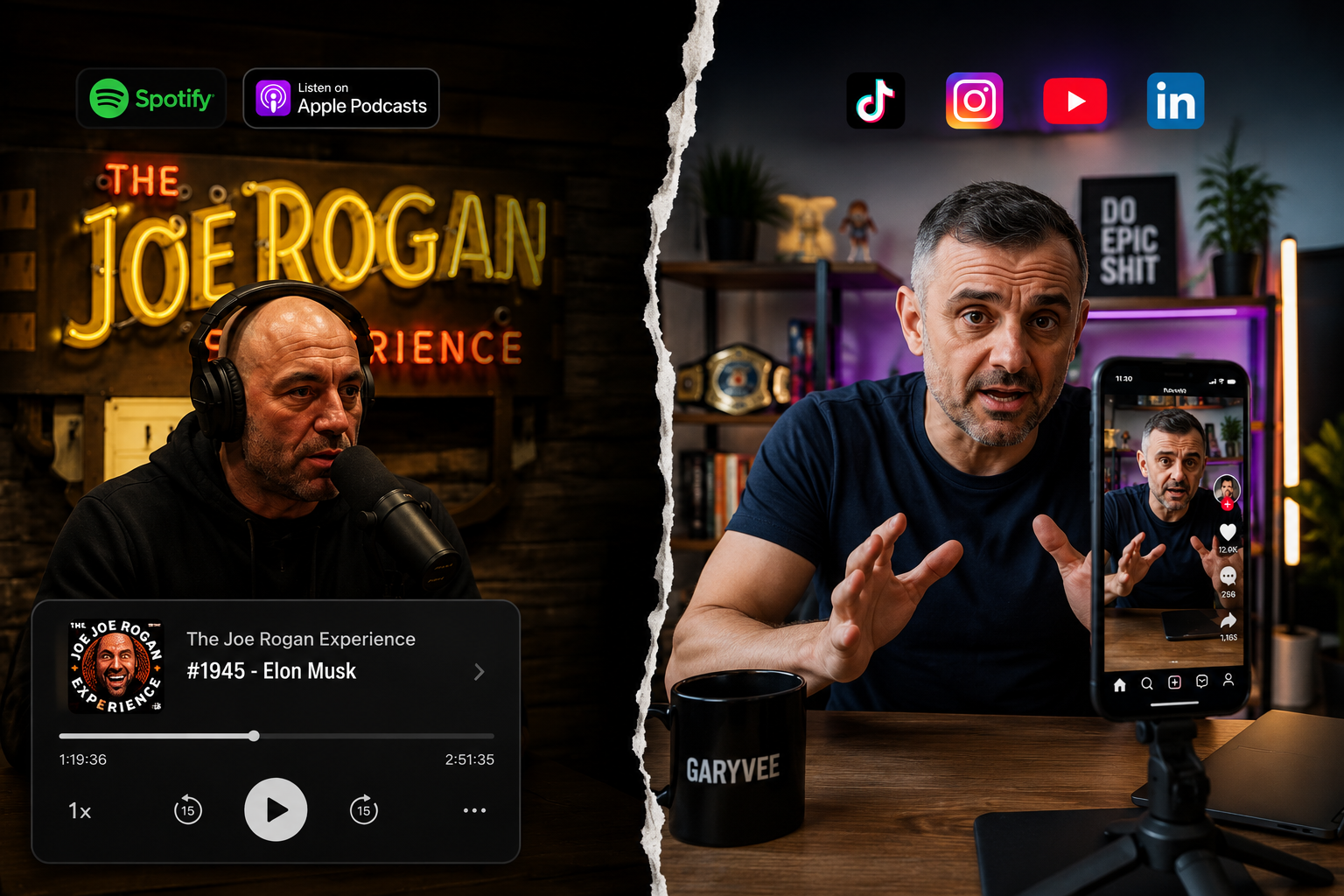
Ask a room full of business owners whether they want a podcast and most will hesitate. Some will shake their heads. A few will say they've thought about it but never got around to it. Almost none will raise their hands with conviction.
Ask the same room whether they want more customers, more trust, better visibility, stronger SEO, and content that keeps working long after they've stopped paying for it — and every hand goes up.
That gap is the identity problem.
Podcasting, as a format, has spent the last decade building an association with entertainment. Joe Rogan. True crime. Celebrity interviews. Comedy. Niche hobbyist shows. The cultural image of podcasting is a person in headphones, recording in a spare bedroom, talking to an audience of strangers about something they're passionate about.
That image is not wrong. It's just incomplete. And for businesses, it's become a barrier — a mental category error that causes them to dismiss one of the most efficient content marketing and authority-building systems available before they've understood what it actually does.
The Category Error That's Costing Businesses Visibility
When a business hears "podcast," they hear "media." They think: Do I have an audience? Do I have something interesting enough to say? Will anyone listen?
These are the wrong questions. They're the questions an entertainer asks. A business has entirely different objectives.
A business isn't trying to build a listenership. It's trying to build trust with the specific people who might one day become its customers. It's trying to demonstrate expertise before a prospect has even picked up the phone. It's trying to create the kind of familiarity that makes its name the first one that comes to mind when someone in its industry needs help.
Podcasting — specifically, video podcasting — is a remarkably efficient way to do all of that. But because the format has been filed under "entertainment" in most people's minds, businesses never get far enough to understand how it actually works as a marketing system.
You're Not Buying a Podcast. You're Buying Visibility.
Here is what a business actually purchases when it invests in a recorded conversation at a professional studio.
It purchases a long-form video episode — the full conversation, edited and published to YouTube, Spotify, Apple Podcasts, and any other platform it chooses. That episode is searchable. It is indexed. It lives on the internet indefinitely, working as a passive discovery asset long after the recording session ends.
It purchases thirty or more short-form video clips — moments from that conversation extracted, captioned, and formatted for Instagram Reels, TikTok, LinkedIn, and Facebook. Each clip is a standalone piece of content. Each one can reach a different audience. Each one reinforces the same message: this business knows what it's talking about.
It purchases a website article — a written version of the conversation's key ideas, optimised for search, published to the business's own domain, and indexed by Google. This is the kind of content that ranks for the questions a business's customers are already asking.
It purchases AI search visibility — because Google's AI Overviews, ChatGPT, Grok, and Gemini are increasingly drawing their answers from businesses that consistently publish useful, specific, well-structured knowledge. A business that records and publishes regularly is building exactly the kind of content corpus that AI search engines reward.
Why Repetition Is Branding, Not Annoyance
There is a principle in marketing called the mere exposure effect. It is one of the most replicated findings in consumer psychology: people develop a preference for things simply because they are familiar with them. Not because those things are objectively better. Not because they've been convinced by a compelling argument. Simply because they've seen or heard them before.
This is why advertising works even when people claim to ignore it. It's why a brand name you've seen a hundred times feels more trustworthy than one you've never encountered. It's why the business that shows up consistently in your feed — not aggressively, not intrusively, but reliably — is the one you think of first when you need what they offer.
Podcasting, done well, is a repetition engine. A business that records once a month and distributes that content across every relevant channel is engineering familiarity at scale. It is not interrupting people. It is not paying for attention it hasn't earned. It is publishing useful knowledge and allowing the people who need it to find it.
One Conversation. Hundreds of Future Customer Touchpoints.
Consider what a single one-hour recording session actually produces when it is handled by a team that understands content marketing.
The conversation itself is the raw material. From that raw material, a skilled production team can extract a full-length episode, a series of short clips, a written article, a set of social media captions, a LinkedIn post, an email newsletter, and a collection of pull quotes suitable for graphics and stories.
Each of those assets is a touchpoint. Each one is an opportunity for a potential customer to encounter the business, absorb something useful, and move one step closer to trusting it enough to make contact.
A business that records twelve conversations in a year — one per month — and distributes each one properly is generating hundreds of touchpoints annually. It is building a content library that grows over time, that continues to attract search traffic, that continues to surface in AI-generated answers, and that continues to create familiarity with the people most likely to become its customers.

Why Conversations Create Stronger Authority Than Traditional Advertising
There is a fundamental difference between telling people you are an expert and demonstrating it.
Traditional advertising tells. A full-page ad in a trade publication tells readers that a business is experienced, reliable, and worth calling. A sponsored post on social media tells followers that a product or service is worth considering. These formats are useful. They are not, however, particularly convincing on their own.
A conversation demonstrates. When a business owner or professional sits down and speaks for an hour about their industry — the problems they solve, the mistakes they see clients make, the questions they're asked most often, the things they wish more people understood — they are not claiming expertise. They are exhibiting it. The audience is not being told to trust this person. They are watching the evidence accumulate in real time.
How Search Has Evolved Beyond Keywords
For most of the internet's history, SEO was a game of keywords. You identified the phrases your customers were searching for, you placed those phrases in the right locations on your website, and you waited for Google to reward you with traffic.
That model still matters. But it is no longer sufficient.
Google's evolution toward AI-powered search — and the parallel rise of platforms like ChatGPT, Grok, and Gemini as primary research tools — has shifted the emphasis from keyword density to demonstrated expertise. The businesses that are winning in search today are not the ones that have stuffed the most keywords onto their pages. They are the ones that have published the most useful, specific, well-structured knowledge about their field.
Google's own framework describes this shift in terms of Experience, Expertise, Authoritativeness, and Trustworthiness — E-E-A-T. The question Google is increasingly asking about a piece of content is not "does this contain the right keywords?" but "does the person or business behind this content actually know what they're talking about?"
A business that publishes a regular video podcast — and converts each episode into written articles, transcripts, and structured web content — is building exactly the kind of content corpus that answers that question affirmatively. It is creating evidence of expertise, published consistently, across multiple formats, on multiple platforms.
Traditional Podcast Studio vs. Content Marketing System
The difference becomes clearest when you compare what each approach actually delivers:
| What you get | Traditional Studio | Creative Creatures |
|---|---|---|
| Full-length episode | ✓ | ✓ |
| Multi-camera video production | Sometimes | ✓ Always |
| Short-form social clips (30+) | ✗ | ✓ |
| Instagram Reels & TikTok content | ✗ | ✓ |
| LinkedIn & YouTube content | ✗ | ✓ |
| Website article / blog post | ✗ | ✓ |
| SEO-optimised written content | ✗ | ✓ |
| AI search visibility | ✗ | ✓ |
| Content strategy guidance | ✗ | ✓ |
| 48-hour delivery | Varies | ✓ |
Built by Marketers, Not Podcasters
Creative Creatures was not built by people who loved podcasting and decided to open a studio.
It was built by people who spent years working in advertising, brand strategy, and content marketing — and who recognised, at some point, that podcasting had become one of the most efficient content production systems available to any business.
The insight was not about audio. It was about leverage. A single recorded conversation, handled correctly, could produce more useful marketing content than a month of traditional content creation. It could generate social media posts, website articles, search-optimised content, and authority-building assets — all from one session, all consistent in tone and message, all reinforcing the same brand.
That is the system Creative Creatures was built to deliver. Not podcasts for the sake of podcasts. A content marketing system that happens to use conversation as its raw material.
The studio in Yarraville — the three cameras, the broadcast-quality audio, the professional lighting, the operator who handles everything — exists to make that system as frictionless as possible for the businesses that use it. You arrive. You have a conversation. We handle the rest.
The Businesses That Will Win the Next Decade
There is a version of the next ten years in which AI-generated content floods every platform, every search result, every social media feed. In that version, the businesses that stand out are not the ones that published the most AI-generated text. They are the ones that published the most genuine human expertise — the ones that showed up, had real conversations, and built a body of knowledge that no algorithm could replicate.
Podcasting, in its truest form, is a hedge against that future. It is a format that is inherently human, inherently specific, and inherently difficult to fake. A business that has spent three years recording conversations about its industry has built something that cannot be commoditised: a documented record of what it knows, how it thinks, and why it can be trusted.
That is not a podcast. That is a competitive advantage.
A Soft Invitation
If you've read this far, you're probably not the kind of business that needs to be convinced that content matters. You already know that visibility drives enquiries, that trust drives conversion, and that the businesses that show up consistently are the ones that grow.
What you might not have considered is that the most efficient path to all of that runs through a single, well-produced conversation.
Creative Creatures is a video podcast studio in Yarraville, Melbourne — eight kilometres from the CBD, with free parking outside. We work with businesses across every industry: accountants, lawyers, builders, healthcare professionals, founders, executives, and anyone else with expertise worth sharing.
We don't make podcasts. We build authority.
Written by
Keir Telfer-Williams